
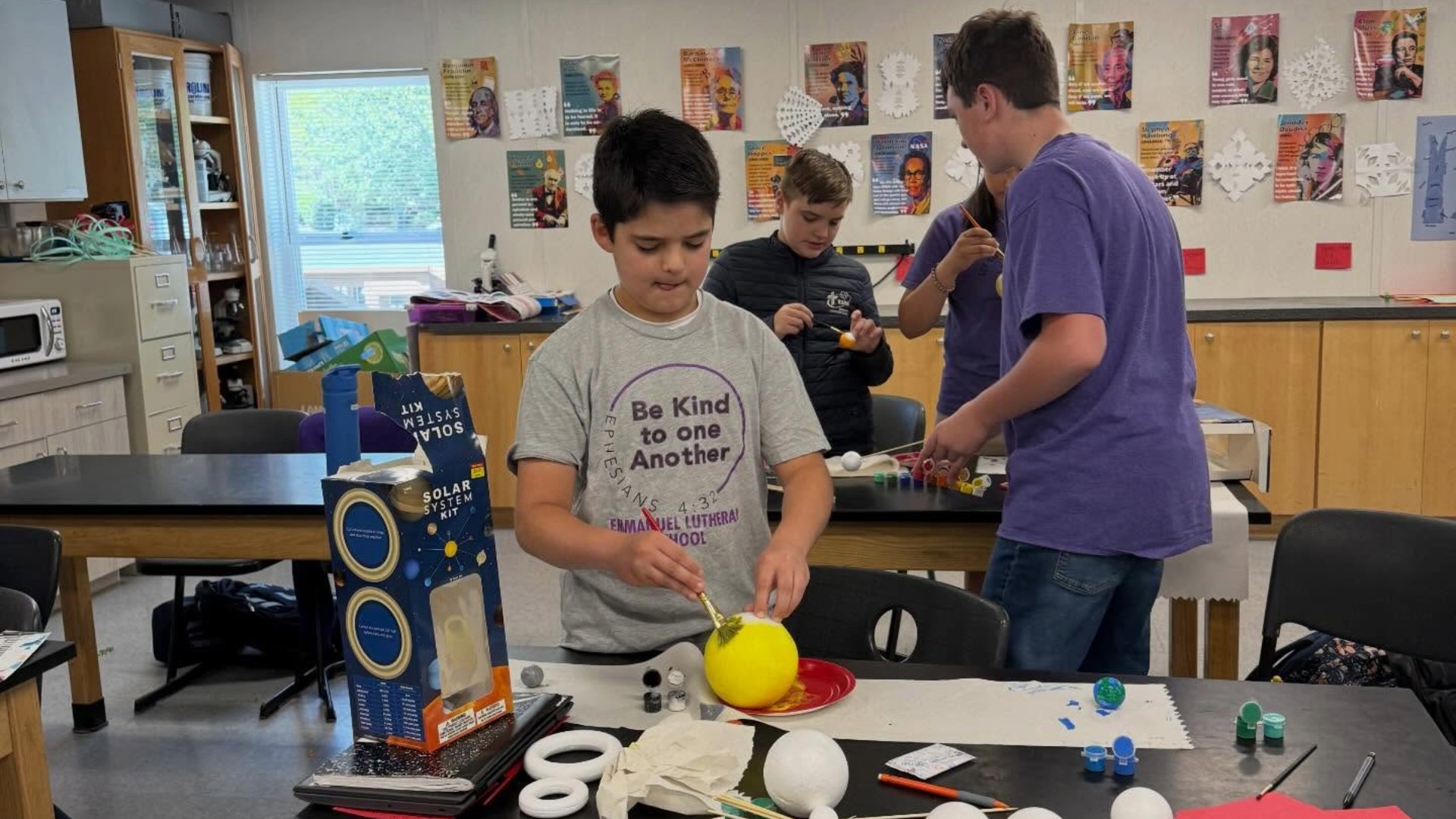
Ask most parents what they want from their child's middle school experience, and the answers tend to cluster around the same themes: a teacher who actually knows my kid, an environment where my child feels safe enough to ask questions, a community where struggling does not mean falling through the cracks. What parents are describing, whether they name it this way or not, is the effect of a small class.
Class size is one of the most researched variables in education. The data is consistent across decades of study: smaller classes produce better outcomes, and the effect is most pronounced during the years when it is most difficult to provide — the middle school years, when students are managing the most personal and academic complexity of their young lives, and when large schools are most likely to let them get lost.
For families in the Asheville area exploring middle school options, understanding what small class sizes actually do for a 12-year-old is worth the time. The answer goes deeper than most people expect.
Quick Summary
- Small class sizes matter most during middle school, when students are navigating both academic and personal complexity simultaneously
- The research on class size and student outcomes is among the most consistent in education, showing gains in achievement, engagement, and long-term confidence
- Small classes change teacher-student relationships in ways that benefit middle schoolers specifically: earlier intervention, more individualized instruction, and genuine personal investment
- In a Christ-centered school, small class sizes amplify the community's ability to develop the whole student, not just the academic one
- At Emmanuel Lutheran School, middle school classes average 10-20 students, making personalized, relationship-driven education the daily norm
Why Middle School Is the Critical Window for Class Size
Elementary students still have a primary classroom teacher who naturally knows each child well. High school students have more agency and can advocate for themselves. Middle schoolers occupy a harder middle ground: they have multiple teachers across multiple subjects, they are navigating the most turbulent period of social and personal development, and they are not yet fully equipped to self-advocate when they need support.
The combination of those factors makes the middle school years uniquely sensitive to class size. Research from the American Educational Research Association consistently finds that middle school students in smaller classes demonstrate stronger academic engagement, lower rates of behavioral disruption, and more positive relationships with teachers than peers in larger classrooms. The mechanism is straightforward: smaller classes give teachers the time and proximity to actually see each student.
In a class of 28-35 students, a teacher moving through a daily lesson can reasonably deliver content to the group. In a class of 10-20 students, a teacher can do something fundamentally different: they can teach each individual. Those are not the same thing, and the difference shows up in student outcomes.
What Small Classes Actually Change
Teachers Can Know Students Before Problems Become Crises
This is perhaps the most concrete benefit, and it is the one most difficult to replicate in larger settings. A teacher who knows 12 students notices things. They notice when a student who is usually talkative goes quiet for a few days. They notice when a child is turning in work that looks technically correct but lacks the engagement that student usually brings. They notice when something is off socially, not just academically.
In large schools with large classes, these signals often go undetected until the problem has already compounded. In a small class, early detection is simply a natural function of the environment. Teachers intervene earlier, parents are contacted sooner, and students get support before they have already checked out emotionally or academically.
At Emmanuel Lutheran School, middle school teachers regularly communicate with parents through the school's online grading system, quarterly report cards, and two scheduled parent-teacher conferences per year. That communication is richer and more specific when a teacher truly knows a student, and small class sizes make that depth of knowledge possible.
Instruction Can Be Genuinely Differentiated
Middle school is a pivotal point in the academic sequence. Students are moving from pre-algebra into algebra, from narrative writing into analytical composition, from memorizing facts into applying concepts. Students arrive at these transitions at different paces, with different gaps, and with different strengths.
In a classroom of 30, teachers design lessons for the middle of the distribution and hope the rest catches up. In a classroom of 15, teachers can see exactly where each student is and adjust accordingly. A student who needs a concept approached from a different angle gets that. A student who is ready to move faster does not sit idle waiting for the group. Studies from the Institute of Education Sciences have documented that the academic gains from differentiated instruction are most accessible in smaller class settings, simply because genuine differentiation requires teacher attention that larger classes cannot proportionally provide.
ELS middle school students work through a challenging curriculum that includes algebra via Big Ideas Math, analytical literature study, Shurley English grammar, and Next Generation Science Standards coursework. The fact that this material is taught in classes of 10-20 students means instruction can meet each student where they actually are.
Students Learn to Self-Advocate
Self-advocacy is one of the most transferable skills a middle schooler can develop, and it is built in environments where asking for help feels safe rather than risky. In a large class, raising a hand or staying after to ask a question can feel socially exposed. Students worry about standing out, looking lost, or taking up time.
In a small class, those dynamics shift. Students know their teacher personally. They know the teacher will not embarrass them. They know their question will be answered rather than deferred. Over time, asking for help becomes normal rather than vulnerable, and students carry that confidence into high school where the ability to seek out support from teachers, tutors, and counselors is directly linked to academic success.
This is one of the reasons many ELS graduates go on to excel in honors and AP courses at their chosen high schools. The self-advocacy habits built in a small, relationship-rich middle school environment travel with students wherever they go next.
Small Class Sizes in a Christ-Centered School: A Deeper Connection
At a school like Emmanuel Lutheran, small class sizes do more than improve academic outcomes. They make the school's faith mission possible in a more complete way.
When a teacher knows each student genuinely, they can speak to the whole person. They can recognize when a student's academic struggle is connected to something personal. They can offer encouragement that is specific rather than generic. They can model Christian care in ways that feel real and personal rather than institutional.
The integration of faith into daily academic life, which is central to the ELS experience, requires exactly the kind of relationship-density that small classes provide. Bible study, discussions of ethics and apologetics, chapel leadership, and the character development conversations that happen across subjects all carry more weight when students feel known by the adults leading them.
This is what Mark 10:14 looks like in practice in a school: not just the aspiration to welcome and care for children, but the structural conditions that make genuine care actually possible every day.
Small vs. Large: What the Research Says
The landmark Tennessee STAR study, one of the most comprehensive class size research projects ever conducted, followed students across multiple years and found significant academic advantages for students in smaller classes, with effects that persisted well beyond the years spent in those smaller settings. Students who spent time in small classes were more likely to graduate from high school, more likely to pursue higher education, and showed stronger earnings outcomes as adults.
More recent research has deepened those findings. A review of class size literature by the National Bureau of Economic Research found that reductions in class size during the middle school years produced measurable improvements in long-term outcomes, including graduation rates and college enrollment, even when the effects on short-term test scores were modest. The benefits of small classes during early adolescence compound over time.
ELS families already have access to this advantage through the school's existing class size structure. But it is worth naming clearly: this is not a premium feature of private school that families should feel lucky to have. It is an evidence-based educational investment in their child's long-term trajectory.
For more on the research behind class size benefits, the ELS blog has covered this topic in depth, including a research-based look at the benefits of smaller class sizes and a direct comparison of small and large school environments.
What This Looks Like Day to Day at ELS
It can be helpful to move from the abstract to the concrete. Here is what 10-20 students in a middle school classroom looks like in daily practice at Emmanuel Lutheran School:
- A student struggling with a pre-algebra concept gets a conversation with the teacher, not a referral to a website
- A student who finishes work early gets a challenge, not idle time
- A student going through something hard at home has a teacher who notices and follows up
- A student preparing for the 8th grade Washington, D.C. trip has teachers who know their interests, their strengths, and what will make the experience meaningful for them specifically
- A student navigating the social complexity of middle school has adults in the building who know the full picture of who they are
This is the daily reality of small-class education at ELS. It is not accidental. It is the result of a school that has structured itself around the conviction that students need to be known, not just taught.
Frequently Asked Questions
How many students are in a typical middle school class at Emmanuel Lutheran School?
Middle school classrooms at ELS typically have 10-20 students. This range allows for genuinely individualized instruction and the kind of teacher-student relationships that research consistently links to stronger academic outcomes and greater student confidence.
Does class size really matter that much at the middle school level?
Yes, and the research is particularly clear about the middle school years. Early adolescence is a period of significant academic and personal transition, and students during this stage benefit more than almost any other age group from environments where they are genuinely known by their teachers. Small class sizes are one of the most direct structural ways schools can provide that.
How does a small class size affect a student who is shy or reluctant to ask for help?
It helps significantly. In large classes, asking for help can feel socially risky, and reluctant students often quietly disengage rather than raise a hand. In small classes, the relationship between student and teacher is close enough that teachers notice the struggle before the student has to voice it, and the classroom culture normalizes getting support rather than treating it as a sign of weakness.
Is class size more important than teacher quality?
Both matter, and they interact with each other. Small class sizes allow good teachers to do their best work. A skilled, caring teacher in a class of 30 is stretched thin in ways that the same teacher in a class of 15 is not. At ELS, every K-8 teacher holds at minimum a bachelor's degree and follows an individual professional development plan. Small class sizes and qualified teachers together produce outcomes that neither can deliver as effectively alone.
How do I find out more about the ELS middle school experience?
The best way is to visit. Seeing a school in person, meeting teachers, and sitting with the community tells you far more than any description can. You can explore the middle school program online, and when you are ready to see it in person, schedule a tour to meet the ELS team firsthand.
Conclusion
Class size is not a minor logistical detail. For middle schoolers, it shapes the entire texture of the school experience: who notices them, how instruction reaches them, whether they feel safe enough to ask for help, and whether the adults around them have enough time and knowledge to invest in who they are becoming.
At Emmanuel Lutheran School, classes of 10-20 students are not a selling point layered over an otherwise standard program. They are the structural expression of a school that believes every child deserves to be genuinely known. For middle schoolers in Asheville navigating one of the most consequential stretches of their education, that difference is not small at all.